

Meet the Award Winners: Shark Diving, Small-Town Cinema and Animation Tips from Our Contest Filmmakers
From the HD Pro Guide Magazine archive: this article first appeared in HD Pro Guide Magazine, Vol. 5, No. 1 (Autumn/Holiday 2017).
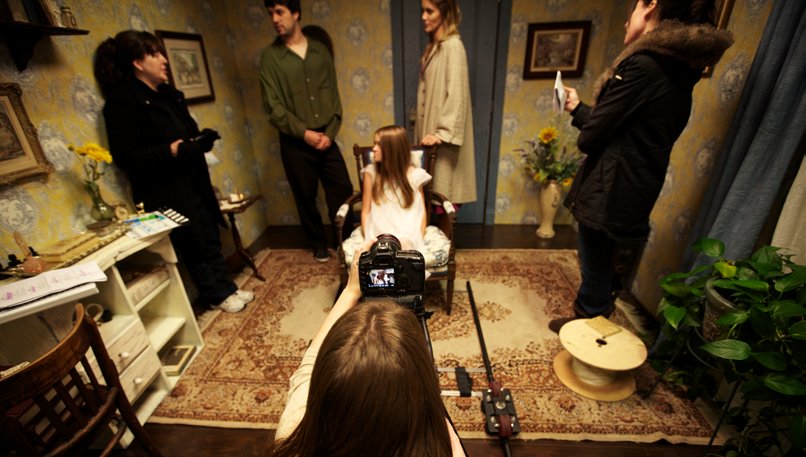
Libby Blood grew up in her family-owned, hand-built, Movie Theater giving birth to a life-long passion for storytelling. Because of this she started making films at a young age. She has made countless films, documentaries, spot feature news stories, PSAs, promos, commercials, music videos, and short films. In the past 8 years, her work has been in over 25 film festivals around the world including the prestigious Festival de Cannes with her short film, LUCY. Blood has been honored with more than 65 awards including Orange County Film Festival’s and Newport Beach’s ‘Filmmaker of the Year’. Libby is the Senior Editor for SVN Student Filmmaking online magazine as well as one of the five members of Cypress College’s Advisory Board for the entire media program there. Blood also does the cinematography for upcoming Sony reality television productions and all commercials for TSL Electronics, and Anjali MD Skincare. She is a cinematographer and edits for Nick Cannon’s Celebrity High TV, Mouthy TV, and handfuls of independent productions. She has edited for MTV, OWN (Oprah Winfrey Network), John Deere, Long Story Short Media, Glamour Magazine, and Sony producers.
Libby’s dream is to edit animated features. Blood works in Avid Media Composer and Adobe Premiere. She is also Certified in Apple’s Final Cut Pro. What inspired the story for your short film, “Lucy”? Libby Blood: I’ve grown up with my younger brother Luke who has autism. As a result of the closest person to me having this disorder I’ve been able to become very close to the disorder as well. Lucy is the visual representation of what I think people like Luke go through on a daily basis.
What did you shoot and edit with? Libby Blood: I shot with the Canon 5D Mark ii with a prime 50mm f1.2 lens as well as others like a 100mm macro and 16-35mm. At the time I edited the film on Final Cut Pro 7. “LUCY” Wins First Place In 2017 Summer Shorts Film and Video Contest Libby Blood: Producer, Director, Cinematographer, Editor, Story
Professional Category winner
Can you tell us about your story’s setting, when and where your story takes place, and the significance?
Libby Blood: Lucy is set in 1939 France for multiple different reasons. This was a time when autism was first being discovered. As a result the average person only thought of it as a problem and something to be frowned upon Isolating Lucy and people like her even more. It’s also set in France to symbolize the language barrier people with autism face. Communication is like a whole different language to them. What were the some of the most important parts for you in regards to pre-production?
Libby Blood: Pre-Production is so important to me when it comes to taking on a project. When the right kind of planning is done for a project it’s potential skyrockets. As an Editor today, post production is very important to me as well. This is where the love and true story telling comes in I think and needs to be taken seriously. Can you share with us a “Challenge and Solution” in regards to the making of “Lucy”?
Libby Blood: There were countless challenges that had to be overcome when making Lucy. One of which was when we were filming the flood scene on our set. it was 3am and we set everything up to flood our set. When we went back to watch the footage our cameras had malfunctioned and stopped recording. We didn’t get it and had to clean up and shoot it again because of our major time crunch on the film. With this and many others, the making of ended up taking on much of the same theme as the film itself. When things got hard we had to buckle down and power through much like Lucy. “My barriers are not my limits; they are my stepping stones to greatness.” If you could share your Top 3 Tips related to filmmaking, what would they be? Libby Blood: Pre-production, story, and pre-production. When you have a story you believe in and the time to plan it right, magic can happen.
What are your thoughts on being selected and winning first place in the professional category of the 2017 Summer Shorts Film and Video Contest?
Libby Blood: I am so incredibly honored to be recognized. It means the world to me that people are seeing Lucy and that they are seeing the significance to it. That’s what it’s all about after all right? I can’t thank Summer Shorts Film and Video Contest enough! “Shooting sharks without a cage, underwater, during a monsoon with five to six- foot waves was an incredibly humbling experience. While it is a wildly exciting, you have to remember that this is not a zoo. These are wild animals and must be treated with respect. I hope people are inspired to educate themselves about sharks, instead of seeing them as “blood thirsty beasts.” We all can do our part. Thanks to everyone that helped me with this short film. Long live the sharks.”
~Jack White, Videographer and Editor What inspired the “story” for “Misguided Fears- The Oahu Shark Diver”? Jack White: The idea for the story started when I met Ryan Bruner, the shark diver, on the North Shore of Oahu. At first, I thought, “man, this guy belongs in a psych ward.” Ryan makes a living swimming with sharks, and educating people about their importance to our ecosystem. Sharks mysteriousness and reputation as an “apex predator” have caused them to become one of the most misunderstood creatures in the animal kingdom. And naturally, as humans, we fear what we don’t understand. With Ryan’s knowledge, I wanted to maybe shed a little light on the subject of sharks, and do my best to help conservation efforts through my video. Next thing I know I’m sitting on the bow of Ryan’s boat at 9am in the pouring rain, wearing snorkel gear, finicking with my camera settings while a dozen 8-10ft sharks circled below me in the water. What tools did you use from development to post?
Jack White: My short film is a classic example of ultra-low budget. In Hawaii, I was living on very little money. So, rather than spend big bucks on gear, I wanted to use the tools I already had to the best of my ability, and focus on the story as much as I could. Two DSLR’s and a rented SPL underwater housing was basically my entire package.
Misguided Fears – The Oahu Shark Diver WINS 2nd Place in Professional Category What was your ultimate goal for your documentary?
Jack White: I really wanted to focus on the sharks, while at the same time telling Ryan’s story. Marrying those two aspects was the ultimate goal in my short film.
Can you share with us a “Challenge and Solution” in regards to the making of your short documentary?
Jack White: I’d say the hardest challenge was trying to fight the enormously powerful ocean currents, while doing your best to get the shots you need. There were times when I would be so focused on shooting, that I would put myself in real danger of being swept farther out to sea by the currents. Some of the best advice I got during my tenure in Hawaii was to, “Never turn your back on the ocean.” I think going into the shoot with that mentality helped me stay safe, and gave me the confidence I needed. Dramamine also helped.
If you could share your Top 3 Tips related to filmmaking, what would it be?
Jack White: Always be a student. Break rules. Love what you do.
What are your thoughts about being selected and winning one of the top placements in the contest? Jack White: I’m stoked to have my work selected by the committee. I really hope people see my video and have at least a little more understanding of sharks’ importance to our ecosystem. I also hope it inspires people to donate, and get involved with the debate of sharks’ importance in our waters.
“Today, we need more creation in this world. Everybody can create something new and find his audience.” ~ Simon Giraud What inspired the story for “Ichnos”? Simon Giraud: Actually, it was the video game, “The Shadow of the Colossus,” directed by Fumito Ueda that inspired me for this project. I love the universe of this Game Designer, and I wrote my story, thinking about these games. I also read many books about mythology (Greek, north mythology) and different legends. This inspired me, because I love this way to explain universe mechanics with a poetic story. But all of that is about the writing process and the universe, you know.
Well, for the graphic design and the animation, I looked for somewhere else. I saw “The Approximate Present,” a great animated movie created by Filippo Baraccani. I love the 3D low poly effect and this visual render. So, I try to transform this 3D render to 2D render. For this process, I use Illustrator, a vectorial illustration software. That seemed to be good, so I chose to keep this graphic render for all movie. What was the animating and moviemaking process like? What tools did you use to animate and edit?
Simon Giraud: That’s a difficult question. You certainly know this, but when you create a movie, you create your own process during all the movie making. Actually, I create all my assets in Illustrator,
WINS 3rd Place in Professional Category If you could share your Top 3 Tips related to animation and movie-making, what would it be? Simon Giraud: Love your work.
Talk about your project. Forget the myth about the genius alone who gets the perfect idea. People can help you. Live life to the fullest. Sometimes, ideas come out from anywhere. So, it’s very important to go out. What are your thoughts about being selected and winning one of the top placements in the contest?
Simon Giraud: That’s amazing! It’s a childhood dream. Create my own movie and be selected in a contest. That makes me want to do more projects in animation, video games, movies… Anyway, this project and contest are a real springboard for me. And now, I just wanna go on!
Film Credits: Director: Simon Giraud Thanks to: Léonie Siegler, Joann Guyonnet, Dame Karine, Sophie Gallo, Laurent Saussol,
Zozo the wizard, the DMA, my Family and the Bro’.
and I import them in After Effects, another software for compositing, you know. In After Effects, I create my shot with the different element created in Illustrator. I bring them to life with a puppet tool and a plug-in named Duik. With this plug-in, I can create a skeleton and bone mechanics with assets and create the animation. That’s the main process for the different shot. At the end, I use Premiere Pro to edit the movie. But you can also check the making of video online, (https://vimeo.com/225968461). What were the some of the most important parts for you in the movie-making process for your animation?
Simon Giraud: I think all the parts are important. In my opinion, it’s a mistake to attach more importance to one part of movie-making process. That will create a loss of balance. A movie is not only a character, or an animation, or a shot, it’s all of that. Sometimes you attach more importance to one animation, however, nobody cares. Maybe because your animation is in the background or just because people see a movie not just an animation. But it’s just my opinion!
Can you share with us a “Challenge and Solution” in regards to the making of “Ichnos”? Simon Giraud: The storyboard process was very difficult for me… It was a challenge! But I eventually find my storyboard after many tries. For one month, I made a new storyboard every week, again and again. Working on my different shots, I eventually succeed in finding something that I liked. I used “the rule of thirds” for example to create my shot. That was not an obligation for me, but that was helpful compose my movie. Sometimes, that’s for you to come back to the theory rule of cinema before breaking the rules, you know.
More from HD Pro Guide: get new production, broadcast and post stories every week with the free HD Pro Guide newsletter.
