

Shooting with the Sony F3: An Interview with Cinematographer Bryan Greenberg
From the HD Pro Guide Magazine archive: this article first appeared in HD Pro Guide Magazine, Vol. 2, No. 1 (2014). By Scott Essman.
Shooting with the Sony f3 what were the main technical reasons you chose to shoot "Trane and Miles" with the Sony f3?
BRyan Greenberg: At the time the F3 was the latest Sony digital camera with features that were compatible with higher end cameras. Its new brother, the F5, has since replaced the F3. I’m going to be shooting with the F5 on the upcoming documentary “Crash Crouse” about the raise and fall of the auto industry. Technically, the F3 allowed me to make choices in the menus that gave me control over the “look” that I wanted for "Trane and Miles" in camera. Also, I was able to use the same lens I have used when I was shooting projects on film.
How do the lens selections and AVAILABILITy for the Sony f3 differ from the others?
BRyan Greenberg: The F3 has a PL mount which is the standard lens mount found on most cameras. They also have lens adapter that will allow you to use most of the lenses that are available today.
You shot "t&m" on two card systems – a PRIMARy one and an aja as a backup system. can you explain how those work and If They are different – and why did you add the aja system?
BRyan Greenberg: We used the AJA so that we could have better color resolution. The AJA allows us to up res the quality of the picture. The on-board card was our backup and allowed us to playback the image for review.
What approaches to camera settings, filters, lens settings, diffusion, or special lighting techniques did you use to create the 1959 period look of the film?
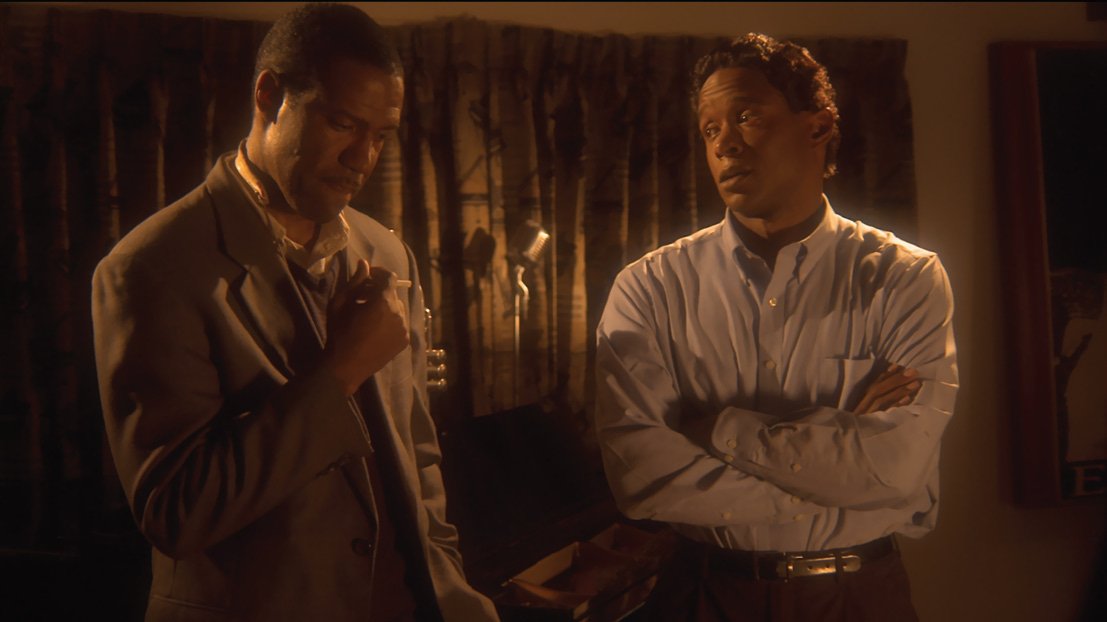
BRyan Greenberg: I really want to give this a look that would put you back in time. I didn’t want to just shoot this in black and white. I wanted to push it a little further. What I did want to do was to create a look that had the flavor of black-and-white but felt like you were looking back at a moment in time, a fuzzy memory, a dream, real but unreal. When you have a camera that provides a lot of features, you have the ability to create a look in camera. I reset the color temperature to create the tone that would help capture the look of the 1950s that I wanted. Also, I tried something for the first time to see what the results would be. I wanted to soften the image, take away any hard edges and open up the blacks a little bit. To achieve this I first started with the lens. I used an old school 25mm to 250mm Cooke lens. I love the glass on the older style lenses. They don’t have the super sharp look of some of the newer HD lenses. With the 25mm-250mm Cooke on the F3, I was able to look at the monitor and compare my filters that I use on film shoots. This gave me a chance to see what would be the best fit for what I was going for. I started with Tiffen diffusion filters and discovered they were too light. To my surprise, I ended up using a Tiffen fog 4. This type of filter would be way over the top on a film camera. But, wow, it really worked well for me. It gave the highlights a little bloom and created a little softness to the overall image. It was just what I was looking for. I would have never thought of going with anything so heavy, but it really worked well. The rest of the look I was going for was filled in with the lighting. I used a lot of C.T.O. of various degrees over the lights. With that combination I was able to create the “look” and really see what I had before any post-production work.
Your dynamic with your camera crew (you as DP Plus AC, gaffer, and key grip) made the workflow so smooth. you shot the entire 19 page script in two days Without going over a basic work day. can you describe how that worked on set?
BRyan Greenberg: It was a bit of luck that I was able to bring on my top crew guys. First, Cameron Cannon has been my A.C. for over 10 years and also works as my camera operator. He is my right hand, knows how I work, knows how to set up the camera to my spec, and has my back. I expect a lot from my A.C., and Cameron has never let me down. Next, my gaffer Mark Shelton, who I met while doing effects work on "Titanic" is excellent. I have brought Mark on many of my shoots. He knows how to light to my style and is very clever when it come to “making it work”. The three of us have done a lot of work together so we have a good short hand that saves a lot of time. My key grip, Frank Garbutt is new to my crew but has more than proven himself to me. He is the type of person that is always thinking. When we didn’t have enough flags, Frank would custom make ones out of black wrap that would be a perfect fit. I think most importantly is we are all very passionate about our work and enjoy working together. Also, I’m a “boots on the ground” person. If you are on my crew, then you are going to be working. I keep it moving. Without my crew I wouldn’t be here talking with you.
For filmmakers who might want to explore using the f3 for their own films, what important factors should be included in their decision?
BRyan Greenberg: That’s an interesting question because in today’s world of cameras there are really only two choices. There are the Sony F3 and F5, the Canon C300 and C100, and I am sure there are a half dozen more cameras out there with the same basic spec: 4:4:2 color spacing 8 bit cameras all under the $15K range. They all create magic and they work well but can lack the punch of higher end cameras. The next level are the REDs like the Epic, the Arri Alexa and the Sony F55, plus I’m sure there are a few more cameras I’m missing with the same basic set-up. These cameras shoot 4:4:4 10 bit for maximum results and sell for around $30K. If you have the budget and going for something that will be on a big screen these cameras would be a better choice. The other big consideration in picking a camera is the workflow and how it will impact the post-production.
For the independent cinematographer, are there any key techniques to using the f3 to Its maximum value while saving the all-important elements of time and MONEy in a tight schedule?
BRyan Greenberg: Every cinematographer has their own style. For me, I look at the camera as an instrument. It is not what the camera can do — it’s what you can do with that camera. There are no buttons on the camera that save time or money; it’s prep, anticipation, the people you work with, and the ability to work ahead. That what saves time and saves money.
You had a dolly the entire weekend for the "Trane and Miles" shoot. how and when did you use this most
EFFECTIVELy?
BRyan Greenberg: We had a Tripod dolly. I was very happy to have it, but there are better dollies out there. Skateboard dollies are easy to make and work really well. But this was free, so we made it work. I shot as much as I could with the tripod dolly. It allowed me to create movement. Plus I could work at the long end of the lens and also have some movement in the shoot. I was able to use the dolly to push in and pull back to create transitions. Also, in the wide shoots I was able to slowly dolly right to left and back. This is one of the best ways to create production value on a small budget. Most of the time on low-budget shoots, the best dolly is the doorway dolly — very cheap and very easy to use.
What other different projects of yours have been best suited to the f3 and why?
BRyan Greenberg: On my next project, “Crash Course,” we really spent a lot of time talking about cameras and doing the research. I settled on the Sony F5. Why? Because at the end of the day, it fit the budget, could handle the lens I want to use, and has better workflow then some of the other cameras for our postproduction.
Plus, after using the F3, I felt more comfortable with what I can do with the Sony F5.
What technical advantages to shooting on film would you like to see included in the world of digital video? BRyan Greenberg:
Two things. First, as crazy as it sounds I really miss an optical viewfinder. That’s left over from shooting on film. At some point, you are lighting with your eye and seeing that frame through a viewfinder without the enhancement of the digital world; it could show me real world lighting and contrast.
The second thing is that for the A.C. or any upcoming cameraperson, be it a DP or camera PA, please learn photography. I cannot state how important it is to know the basics. If you want to be a professional, you have to know what photography is all about. Without having that knowledge, you will never be able to set yourself free to really explore, experiment and sleep at night.
Indie filmmakinginterview with cinematographer BRyan Greenberg
More from HD Pro Guide: get new production, broadcast and post stories every week with the free HD Pro Guide newsletter.
