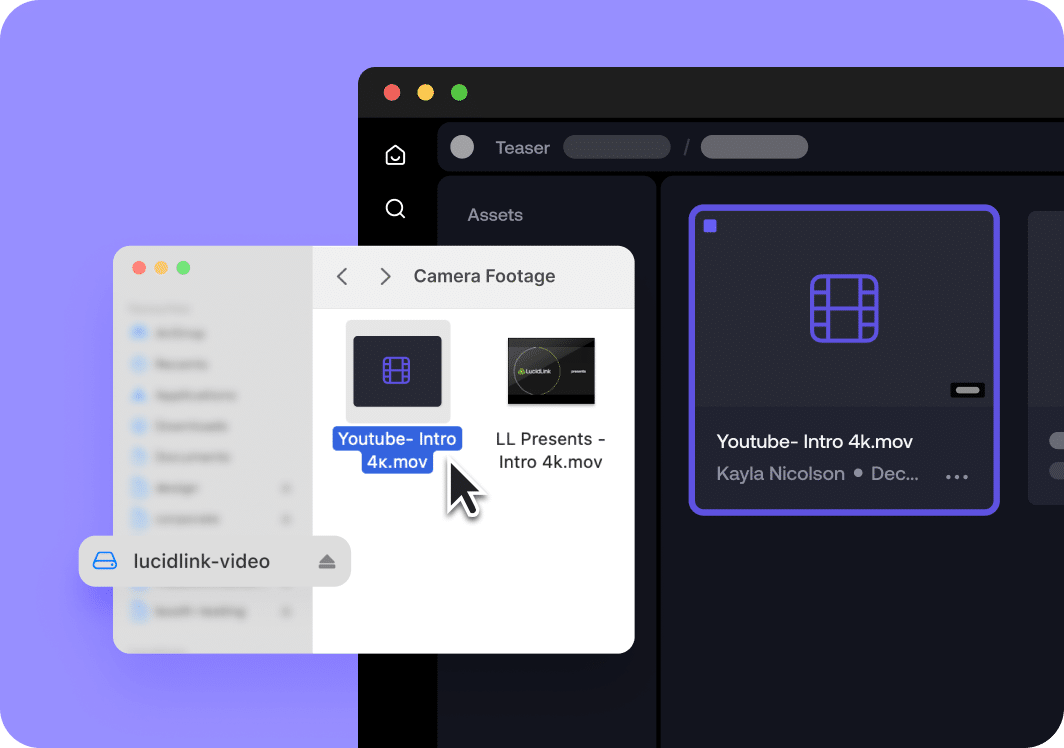
LucidLink, a leader in cloud-based file services for content creators, today announced an enhanced workflow integration between LucidLink and Adobe Frame.io that gives globally distributed production teams unified access to their Frame.io projects and supporting production media in separate cloud storage environments.
By extending the Frame.io ecosystem, LucidLink provides a complete production workflow where editors and producers can access their Frame.io assets alongside all supporting production media — including B-roll, audio, graphics and archives — all within a unified LucidLink filespace. The new Frame.io integration is detailed in the LucidLink blog and product page published today.
Powered by LucidLink Connect, files stored in cloud environments like Microsoft SharePoint, Dropbox, Google Drive, Box, Amazon S3 and more appear instantly for the editor. There is no data migration, downloads or file duplication required, and existing cloud storage systems remain unchanged.
This approach extends LucidLink’s file streaming technology to assets outside Frame.io, bringing local, real-time performance to the rest of the production workflow. Creative teams can collaborate in Frame.io while maintaining a single, real-time source of truth across the rest of the production toolchain, providing a true Camera-to-Timeline experience.
“Creative teams don’t work in a single application anymore. They move across NLEs, MAMs, review and approval tools and VFX platforms,” said Peter Thompson, CEO, LucidLink. “Our integration with Adobe Frame.io means customers can enjoy an exceptional review and collaboration experience, while LucidLink provides the persistent, tool-agnostic storage layer behind it. You get the best of both worlds: a seamless Frame.io workflow and a cloud filespace that serves every other tool in the production.”
As more vendors introduce their own integrated storage options, many media organizations are re-evaluating how to architect their workflows. While application-specific storage can simplify narrow use cases, it often creates silos when content needs to move beyond a single platform.
LucidLink Connect addresses this challenge by acting as an enterprise-grade access layer across the entire production workflow. Content being reviewed and approved in Frame.io can simultaneously be used by other tools, such as NLEs, finishing systems, MAMs or AI services, without additional exports, syncs or manual handoffs.
Key benefits of the LucidLink and Adobe Frame.io integration include:
-
- Immediate Camera-to-Timeline workflows: footage uploaded to Frame.io instantly appears on the editor’s timeline. Teams move seamlessly from ingest to real-time editing without waiting for file transfers or exports.
- Everything in one place: editors no longer hunt for assets across separate systems. B-roll, audio and graphics from SharePoint, Dropbox, or Amazon S3 exist alongside Frame.io media in a single, tool-agnostic LucidLink filespace.
- Zero file movement or duplication: keep data exactly where it lives. LucidLink eliminates redundant export-and-reimport cycles, saving massive amounts of egress costs, administrative overhead and duplicate file transfers.
- Enterprise-ready orchestration: built for IT and media infrastructure teams to automate asset access and scale global pipelines securely without additional infrastructure, data duplication, or complex migrations.
“Over the years, Adobe and LucidLink have teamed up to help organizations like Brut, Casual and Minute Media, plus hundreds of other joint customers, do their best work. That success continuously informs our roadmap,” said Peter Thompson, CEO, LucidLink. “This integration isn’t about choosing one storage option over another. It gives customers the flexibility to design workflows that match the way they actually work. LucidLink Connect provides a neutral, high-performance storage layer that lets Adobe Frame.io shine at what it does best, while ensuring assets are always ready for the next stage in production.”
From high-end episodic and feature projects to live sports and fast-turn social content, organizations are increasingly relying on hybrid and fully remote teams. The LucidLink and Adobe Frame.io integration supports:
- Media & entertainment studios and broadcasters delivering premium content on tight deadlines with globally distributed teams.
- Sports and live event producers who need to ingest, log and cut highlights from the field while collaborating with centralized teams.
- Brand, agency and in-house creative teams running always-on campaigns and multi-channel content programs.
- Enterprise video teams producing internal and external content at scale.