

Cinephotography with the Sony F55: Jeff Berlin Pulls Stills from 4K Motion
From the HD Pro Guide Magazine archive: this article first appeared in HD Pro Guide Magazine, Vol. 2, No. 2 (2014). By Jeff Berlin.
Sony Artisan Jeff Berlin, a still photographer turned DP, set out to shoot a fashion story on the Sony F55 CineAlta in 4K RAW with one goal: pulling magazine-quality stills straight from motion footage. Here’s how he did it, and what he learned.
From an airplane wing to an idea
A few months ago I was hanging out the side of an airplane, 3,000 feet up at almost 150 miles per hour, shooting 4K video of an air show pilot flying with us in close formation. The spinning prop of his flying hot rod, clawing the air at about 2,500 RPM, was barely ten feet from my head. Not my favorite place to be, but just another day at the office.
I was using one of Sony’s new 4K camcorders, the FDR-AX1, and back on the ground the footage looked amazing. Screened on a 4K display, I felt like I could reach into the TV and run my hand along the smooth composite wing.
For most of my career I’ve been a still photographer, specializing in celebrity portraits, fashion, beauty, aviation and rodeo. In the past couple of years I’ve moved into motion, and last autumn I was DP on my first low-budget indie feature, shot in 4K RAW on the Sony F55. When I delivered the air show film to the pilot, I also sent him a few stills rendered from the footage. They looked as good as anything from a professional DSLR, with slightly greater depth of field from the camcorder’s small sensor.
That got me thinking. I wanted to shoot a fashion or beauty story with a motion picture camera, with the specific intent of pulling only stills, and to do it on the large-sensor F55 in 4K RAW to take advantage of its dynamic range, exposure latitude, bit depth, S-Gamut and S-Log2 color, and shallow depth of field. The F55’s 4K resolution is 4096×2160. My 10-megapixel Leica D-LUX 3 shoots 4224×2376, so I figured that would be enough resolution for magazine stills, especially with a little help in Photoshop.
Shooting at 24 frames per second
Shooting stills at 24 fps was an interesting idea. Talk about capturing the decisive moment: it’s like a superfast continuous motor drive. My fastest camera, the Sony a77 DSLR, tops out at 12 fps, and that’s a burst limited by buffer size and write speed. I also started out loading film by the roll or sheet, so even with cards that hold thousands of exposures, I still consider each frame and shoot deliberately, never “spray and pray.”
More and more clients now ask for motion content along with stills. It’s rare that a photo shoot is just a photo shoot. For many of us, that convergence began with the Canon 5D Mark II and its high-quality stills plus cinematic video, which changed the game for photographers. But at the time of writing, DSLRs from Sony, Canon and Nikon all shot video at 1920×1080 (except the Canon 1D C), so pulling publication-quality stills from their video wasn’t really an option.
The F55 takes that convergence further, even though it’s a dedicated digital cinema camera. It shoots top-quality 4K footage and lets me pull stills with enough resolution to publish in a magazine, which no DSLR could do. Yes, the F55’s sensor works out to only about 10 megapixels. But years ago, when I still shot Kodak film for work, my only digital camera was that little Leica, and I submitted its files to magazines without a single complaint. They reproduced just fine.
Before my test I did some research and talked with friends, and learned that what I was doing has a name: cinephotography. A handful of photographers had used digital cinema cameras to capture stills, or rendered print stills from footage shot for commercials and other projects.
The camera test
I organized a test with a model from LA Models at my loft in downtown Los Angeles, and since I was also booked to shoot a fashion story for an L.A. magazine, I planned to use the F55 for that too. Some of my settings:
- 4K RAW. For all the benefits RAW brings. Coming from DSLRs, RAW was one of the easiest cinema camera concepts to translate.
- 45-degree shutter. A 180-degree shutter wouldn’t freeze enough motion. At 24 fps, 45 degrees equals 1/200 second: fast enough to limit blur, slow enough to show a little movement in hair.
- ISO 1,250. Firmware 3.0 unlocked the RAW exposure index, but 1,250 is the sensor’s native ISO and gave ideal latitude and dynamic range in my sunny loft.
- Internal NDs. The F55’s two built-in ND filters let me shoot between wide open and f/2.8 on an 85mm T2 Sony PL-mount lens.
- Monitoring. Monitor LUT set to Rec. 709 Type A (also new in firmware 3), which looks good for skin tones and saturation, with zebras at 70% and white focus peaking.
Rolling on my model, Carly, I directed her through expressions and poses while shooting efficiently, since I was writing to the AXS card at about 1 gigabit per second. After shooting a feature on the F55, I wasn’t worried about RAW file sizes or workflow, but I still shot concisely and asked her to hold for a second or three when she hit a sweet spot. The test came to 178GB of footage.
From RAW footage to a magazine still
I copied the card to a USB 3.0 RAID and reviewed the files in Sony RAW Viewer, free for Mac and PC. Scrubbing frame by frame, I found there’s a fine line between capturing the perfect moment over and over at 24 fps and overkill. The key is not to overshoot: keep your model moving, and pause slightly at the key moments.
- Make your selects and give them a quick grade in Sony RAW Viewer, adjusting density, color and contrast for a good starting point.
- Mark each single frame as both the in and out point and render it as a DPX file. Each was just over 53MB and opened directly in Photoshop.
- Retouch in Photoshop, then save a TIFF as the final for the client and a smaller JPEG for social media. Save a graded DPX (Photoshop saves it as a Cineon file) as a kind of digital negative.
The steps are very similar to my normal photo workflow, where I import RAW files from my Sony a7R, edit and grade them in Phase One’s Capture One, and render high-resolution TIFFs for retouching in Photoshop.
The fashion shoot
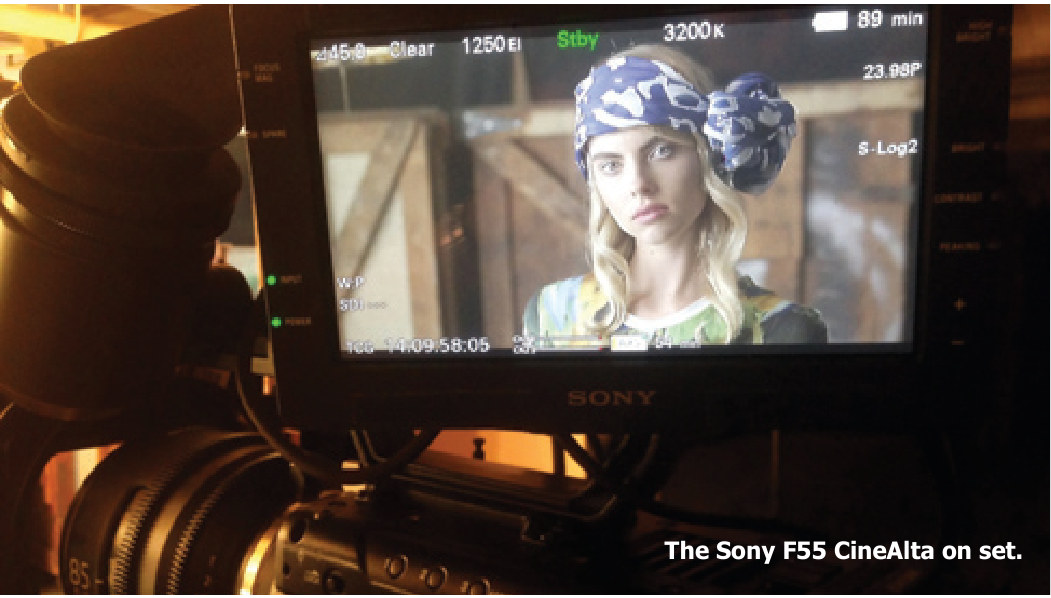
Happy with the test, I fired up the F55 a few days later at Mack Sennett Studios in Silver Lake, a studio dating to 1916 and the silent era, where the Keystone Cops were filmed. This time there was a full crew of editors, hair and makeup, stylists and assistants. I built the camera up with the OLED viewfinder, Sony’s 7-inch Full HD monitor, and a follow focus, matte box and solid support from Digital Film Studios near Burbank. I also connected an Atomos Samurai Blade monitor/recorder so its footage, from my exact shooting perspective, could be cut into the behind-the-scenes film an assistant was shooting on a DSLR.
One thing stood out: when the camera is rolling there’s no shutter click. Many models rely on that click for affirmation, pace and momentum, so my direction had to be continuous and even more specific than usual. I was in a constant monologue with my model, and I could see it took her a little while to adjust.
Because the images were for a client, I backed myself up with my a7R. I found that full-length fashion on a cinema camera, as opposed to beauty or portraits, pushes the lower limit of what I’m willing to submit to a magazine at about 10 megapixels: with the camera horizontal, the model fills too little of the frame to crop in with enough resolution and detail.
And yet, as I write this, the magazine’s creative director has sent the layout selects. On page six is my model, Wylie Hays of Next Models, seated on an apple box, demure and confident, a long white coat draped over her shoulder. It’s the best frame from that outfit and my first choice, and it was shot on the F55. A perfect moment.
Where cinephotography fits
I’m looking forward to shooting more with the F55 specifically to pull stills. For beauty and portraits, where the subject fills much more of the frame, the resolution and quality are more than enough. It’s great to capture the exact moment, angle and expression, though having too many good frames can make picking the final one harder. I see cinephotography becoming more popular as another option for photographers taking the convergence of stills and motion to the next level. The technology is finally here.
More from HD Pro Guide: get new production, broadcast and post stories every week with the free HD Pro Guide newsletter.
