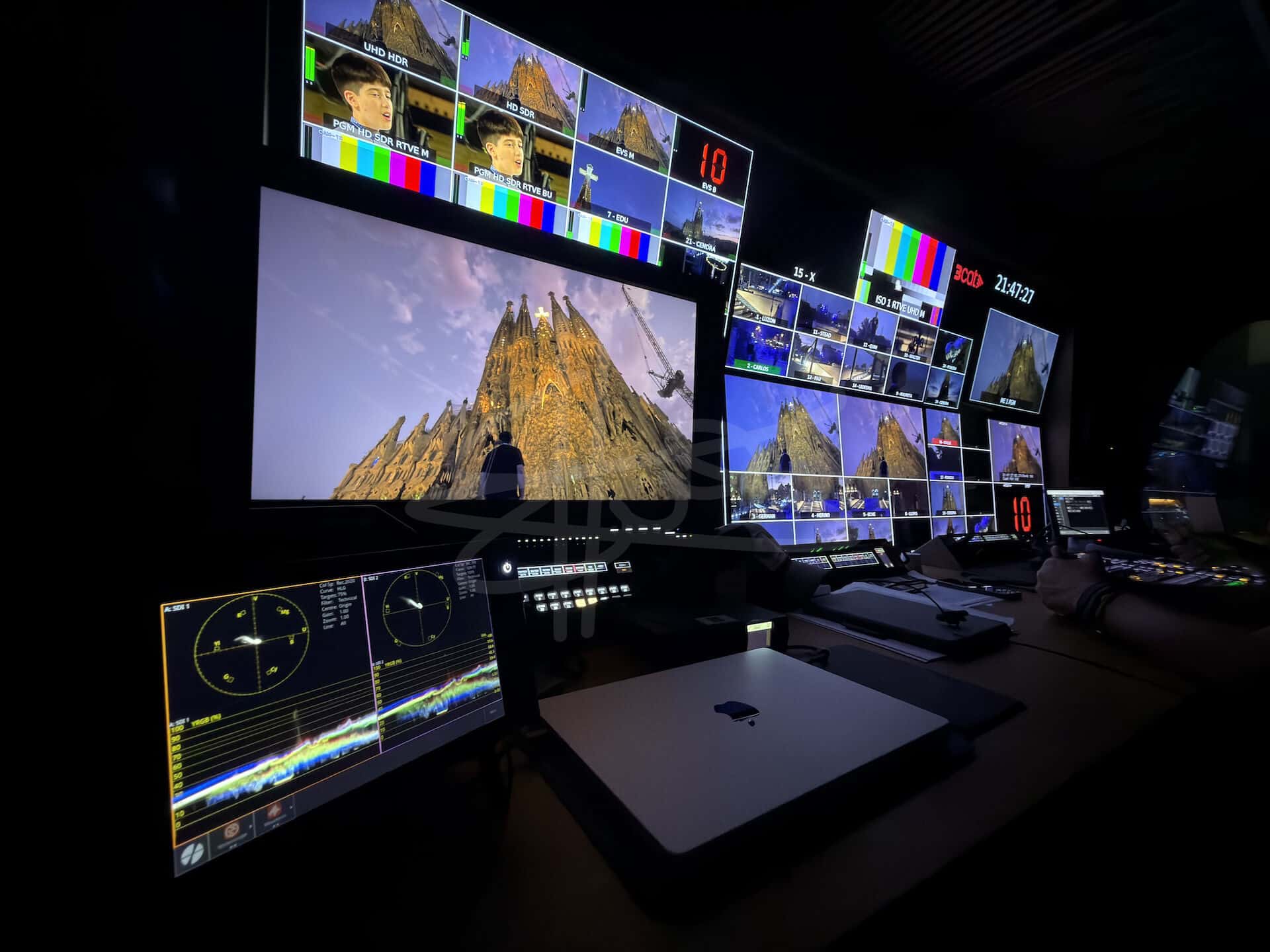
Test & measurement innovator, Leader Electronics of Europe, is proud to announce that two of its leading products, the PHABRIX Qx rasterizer and LeaderPhabrix LPX500 waveform monitor, were employed during the live production of the recent event held at the Basilica of the Sagrada Família in Barcelona, Spain. Taking place on June 10, the production captured a historic visit by Pope Leo XIV to the church, marking both the centenary of the death of the basilica’s legendary architect, Antoni Gaudí, and the recent completion of the Tower of Jesus Christ.
The much-loved house of worship has been under construction for 144 years, and it is anticipated that it will be a further decade before it is fully complete. But there is no doubt that the finalization of the Tower of Jesus Christ represents a hugely significant moment; not only is it the Sagrada Família’s centerpiece, but it is also the world’s tallest church tower at 172.5 meters tall.
Accordingly, expectations were sky-high for the broadcast production of the Jesus Tower inauguration, coinciding with the Holy Father’s visit, which was overseen by the national Catalan broadcaster 3Cat (TV3). Production director Pauli Subira Claramunt worked to realize artistic director Igor Cortadellas’ vision of an event that encompassed both the interior and exterior of the church, and required cinematographic techniques and technologies, some of which – like Sony’s Cinema Line cameras – had not previously been used in a European international UHD/HDR live broadcast.
“Regardless of the cost that UHD/HDR might have [for an event like this], the importance of the production and the relevance in terms of archival and distribution is so large that it doesn’t really matter if it’s more expensive,” says Hector Sole-Bradshaw Beltran, the broadcast engineering consultant who served as technical director for the project, and who describes his primary hurdle as “how to unify two fields of expertise – the broadcast engineering requirements of Tier One production, and digital cinematography tools.”
With so many technical challenges in play, it’s not surprising that Sole-Bradshaw wanted to employ some of his enduring ‘go-to’ production tools – including two from the Leader Electronics product range. Indeed, he reveals that he “always brings” his PHABRIX Qx advanced rasterizer to a production, adding that it “surely has a place in any high-end OB deployment in the world. What I tend to do is have a V-Lock battery powering the unit, so I don’t need to have it plugged into mains, and that allows me to move to different places in the engineering footprint and do the required testing and analysis.”
Sole-Bradshaw also brought along a LeaderPhabrix LPX500 quad 4K-input hybrid IP/SDI waveform monitor, which in this instance was used to display and monitor 4 x 12G-SDI signals (there was no IP element to this production). He notes: “I was able to check a camera anytime during the show or rehearsals, including both HDR and SDR sources. Again, it’s another item of very reliable equipment that helped make the production run smoothly.”
With a mere two days to accomplish the load-in and set-up, and the architectural and physical constraints of the basilica creating plenty of challenges for the broadcast teams, there was a lot riding on the events of June 10. But Sole-Bradshaw confirms that the production went very well and the Leader T&M equipment certainly played its part, adding: “One of the most difficult things to do nowadays, especially when you take into account different political and religious beliefs, is to arrive at a production that is pleasing to everyone. But by focusing on the building itself, which is outstanding and unique in the world, it was one of those occasions where there was universal acclaim and people were left with a really beautiful memory of the day.”