

Inside the Producers Guild’s 2017 “Produced By” Conference
From the HD Pro Guide Magazine archive: this article first appeared in HD Pro Guide Magazine, Vol. 5, No. 1 (Autumn/Holiday 2017). By Scott Essman.
Created by the Producers Guild of America By Scott Essman Sprawling across the 20th Century Fox movie studio lot on the west side of Los Angeles, the 2017 Produced By Conference, created by the Producers Guild of America, offered numerous expert panels on all manners of producing original creative content for various media platforms.
Beginning the proceedings, Chief Content Officer for Netflix, Ted Sarandos, was interviewed by comedian, actor, and project sponsor Jerry Seinfeld. Though Sarandos got his start innocently working in a nascent video store in Phoenix in 1970s, his life was forever changed when he met Reed Hastings, the founder of Netflix, in 1999. Sarandos noted that the concept of entertainment coming into people’s homes on the internet was pure fantasy in the late 1990s. Nevertheless, Sarandos was struck with how Hastings was “so clear-headed about it.” At present, Netflix has 100 million subscribers.
Stating that “consumer access to content drives this whole industry,” Sarandos does not see theatrical distribution of films as being in conflict with Netflix and other online distribution platforms. “We’re setting out to make great movies, and people can get them where they want,” he said, advising producers to simply “make content that is so undeniably great that people will choose it no matter what.”
Sarandos further noted that television distribution in major broadcast network terms is outdated, as is the ratings system. “Whatever wins is a hit, and whatever doesn’t is a failure,” he said of the ratings game. “We get to keep the shows running longer. I find that the best stuff works all the time — we don’t have any time slot. We eliminate that.” In the case of Netflix shows, such as Stranger Things, Sarandos explained how his various series survive without the need for high ratings as with most prime time network TV. “The measurement for an overnight rating is super relevant if you are selling live advertising,” he said. “Relative to what you spend, are people watching it? We only do full seasons, much like green-lighting a movie. It totally differentiates us from television. Our art is picking the right stories and storytellers, and create an environment for them to do the best work of their lives—like the film business in the 1970s.”
In the second major panel at the Produced By Conference, director Damien Chazelle and producer John Wells discussed the working relationship between the producer and director on a film. At first, Chazelle began his ascent into the industry solely as a writer. “I wanted to direct but couldn’t find a path to that,” he recalled. “I started to sell a few spec screenplays and started getting writer-for-hire jobs, not dealing with the financial realities of how to put a movie together. On the side, whenever I could, I’d be writing stuff that was more personal and stuff that I would want to hold onto to direct myself. One of those scripts wound up in the hands of another pair of producers and started getting going – Whiplash.”
Unquestionably, the success of Whiplash vaulted Chazelle’s career and led to La La Land where he initiated collaborations with two upcoming producers. “We were all pretty inexperienced,” Chazelle revealed of the eventual $30 million project. “I started to pitch them the basic broad strokes, and we built the film together with my composer who was writing the songs— Justin [Hurwitz, the composer] had been my college roommate. They gave me the freedom to not think about numbers—we kept adding bigger and bigger sequences. We eventually found Lions Gate to put up the money. Producers Fred [Berger] and Jordan [Horowitz] protected me and supported me, often in ways I didn’t even know at the time. They were good at staying enthusiastic on their end and keeping me and Justin enthusiastic. On La La Land, there were three producers on set with me; I could trust every single one of them.”
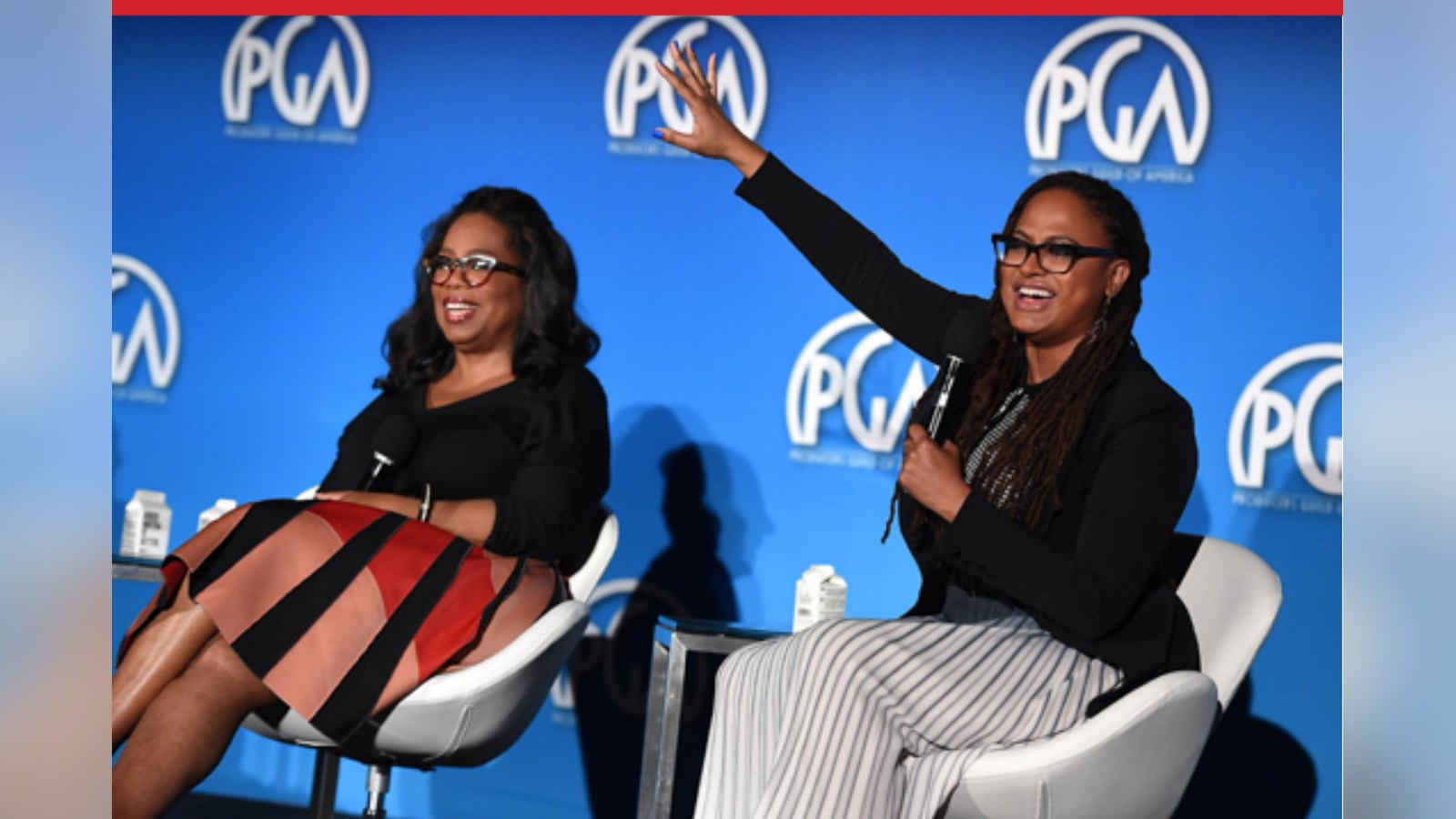
In the event’s last major panel, the entire lot was abuzz in anticipation of Oprah Winfrey interviewing Ava DuVernay onstage. Some five years ago, Winfrey was introduced to DuVernay by actor David Oyelowo who played Dr. Martin Luther King, Jr. in Selma. “As I’m leaving the makeup trailer on The Butler, he asked me if I’d look at a DVD, and it was Ava’s movie,” Winfrey said of Middle of Nowhere. Very soon, a personal and professional friendship developed between DuVernay and Winfrey.
Thereafter, DuVernay and Oyelowo asked Winfrey to collaborate with them on Selma. “They finally said, ‘Why don’t you come on board as a producer?’” Winfrey recollected, joining DuVernay’s set on Selma, also playing a smaller role in the film. Winfrey was immediately impressed by DuVernay’s skills as a director. “She is masterful in control of the set and commanding respect. The crew is willing to do whatever they can for her because she’s willing to do whatever she can for them. Her hands-on approach to everything is what made me develop a higher level of regard and respect for her.”
After Selma, DuVernay visited Winfrey’s ranch in Maui, Hawaii with the pure intention of vacationing together, or so it seemed. “I wanted her to relax,” Winfrey quipped, “but I wanted her to read Queen Sugar [the novel by Natalie Baszile]. She read it, and, on the plane, on the way home, she sent me a ten-page outline — a vision of what it could be. Then, we were off to the races.” Inevitably, Queen Sugar became a 2016 television series on the Oprah Winfrey Network. The show concerns three siblings who move to Louisiana to lay claim to their departed father’s sugar cane farm. For Queen Sugar, DuVernay, the show’s stated creator, and Winfrey share co-executive producer credits, along with other producers; DuVernay has also directed episodes of the series. “It was green-lit straight to series because she also owns her own network,” DuVernay joked. “I had never adapted someone else’s work… I get in there and I go overboard. That draft was the pilot – the first episode.” Of note, Queen Sugar’s second season began at the outset of summer 2017 with a two-night premiere. “Season one, we were finding our way; season two, we’ve all come back—our voice is valid,” said DuVernay. “The show has been wildly embraced by women and people of color. What makes this different is that it’s steeped in African-American culture and southern culture. We try to take care with that and have confidence in that voice. Hollywood is set up in a way that does not center women and people of color. [There are currently] over 500 scripted shows; less than a dozen have black protagonists at their center. I want this show to feel like me.” Winfrey added that she has been proactive about ensuring that women and people of color comprised the crew of Queen Sugar. “What’s exciting is that all of those women directors from season one, we can’t book them,” she said of her hand-picked directors in addition to DuVernay. “We were inundated with calls asking about these women.”
Next from DuVernay is A Wrinkle in Time which will be the first time an African-American has been hired to direct a film with a budget of at least $100 million. “When they first told me about this book, they said, ‘Disney is sending over A Wrinkle in Time,’” she related. “I didn’t believe they were sending it for me. I picked up a camera for the first time at the age of 33 — I don’t have film school friends. I’m literally coming in from the back door; I don’t know anyone.” Though she wasn’t a fan of the book, Oprah noted the universality of projects such as A Wrinkle in Time, in which Winfrey has a role but was not a producer. “In the films I produce I’m trying for people to express the fullness of their humanity in the moment,” she said. “There is a frequency at which we all are the same — we all are whole. When you hit that frequency, it elevates you, and you get to be a little bit more of who you are. There’s something that happens to your own spirit that makes you feel a little bit more real, more human. That is the beauty of what art can do.”
More from HD Pro Guide: get new production, broadcast and post stories every week with the free HD Pro Guide newsletter.
