

Produce, Write and Edit Your Documentary
From the HD Pro Guide Magazine archive: this article first appeared in HD Pro Guide Magazine, Vol. 2, No. 4 (2014). By David Lent.
by David Lent A masterful film, television series, documentary, commercial or music video is created through the guidance of a personal vision. Without creative control by one person, a project will either dissolve into fatal anarchy or the result will appear to be the compromise of a committee, as is often the case.
In 1980, my wife Susan and I received the blessing of author and historian Studs Terkel to develop a documentary series based on his best-selling book, “Working”. We decided to co-produce a pilot called, “Staying Alive” – profiles of four “ordinary” working people. What began as a fun project turned, once we got into the editing room, into a nightmare. We fought often over editorial decisions. At our wit’s end, yet determined to finish the pilot, we decided each of us would take creative control over (that is, produce) two of the four profiles. Once we ‘mine swept’ the work of co-producing, we finished the project with our partnership, and
At times you may partner with collaborators who bring indispensable money, access or expertise to a project. There will be disagreements and conflicts about both direction and details. As a producer or director, you may have to make difficult, sometimes painful, decisions to defend the integrity of your vision. Susan and I were able to move a stuck project forward and avoid disaster by adopting what we call, The Creative Control Credo: When you feel strongly about it and I don't, we go with you.
When I feel strongly about it and you don't, we go with me.
When neither of us feels strongly about it, we flip a coin.
When both of us feel strongly about it, we go with me. (the producer) It is an effective system. Often, a partner’s ideas will be as good as yours or better. An astute producer or director invites the entire team’s creative input. Only when passionate disagreement threatens to stall or undermine a project is it time for The Credo. A working knowledge of camerawork, lighting and audio strengthens a producer’s grasp as a manager on location. Yet producing or directing involves a different mindset (left brain dominant) than shooting, lighting or audio (right brain dominant). Budget permitting, avoid doing both at the same time. With video, directing may merge with producing; this combination is more compatible than producing or directing and shooting. As the manager-on-location, a producer, director or reporter is responsible for the crew’s well being. A detailed and flexible shooting schedule including set up time and a meal break allows the crew to visualize the day and pace themselves accordingly. Send copies of the shooting schedule to everyone involved. If the day must exceed eight hours, add two (or more) 15-30 minute breaks. If meal or rest breaks must be infrequent, make sure water and energy-restoring snacks are provided.
Unless you have a specific shot list in mind, ask your shooter – before directing the camerawork – what s/ he has in mind for a scene or an event. You may be offered angles or options you might not have considered, or creative ways to enhance your own ideas. There may be interesting backgrounds that take priority over the direction of the light. Or objects you want shot as b-roll that, after a few minutes of thinking time, could be composed in a creative way. Give direction about what to shoot, not how to shoot it. The crew is there to make you happy, so put experienced imaginations to work. Keep communication with your crew open, clear and current. Let them know your intentions and give them a running account of what you think about the way things are going.
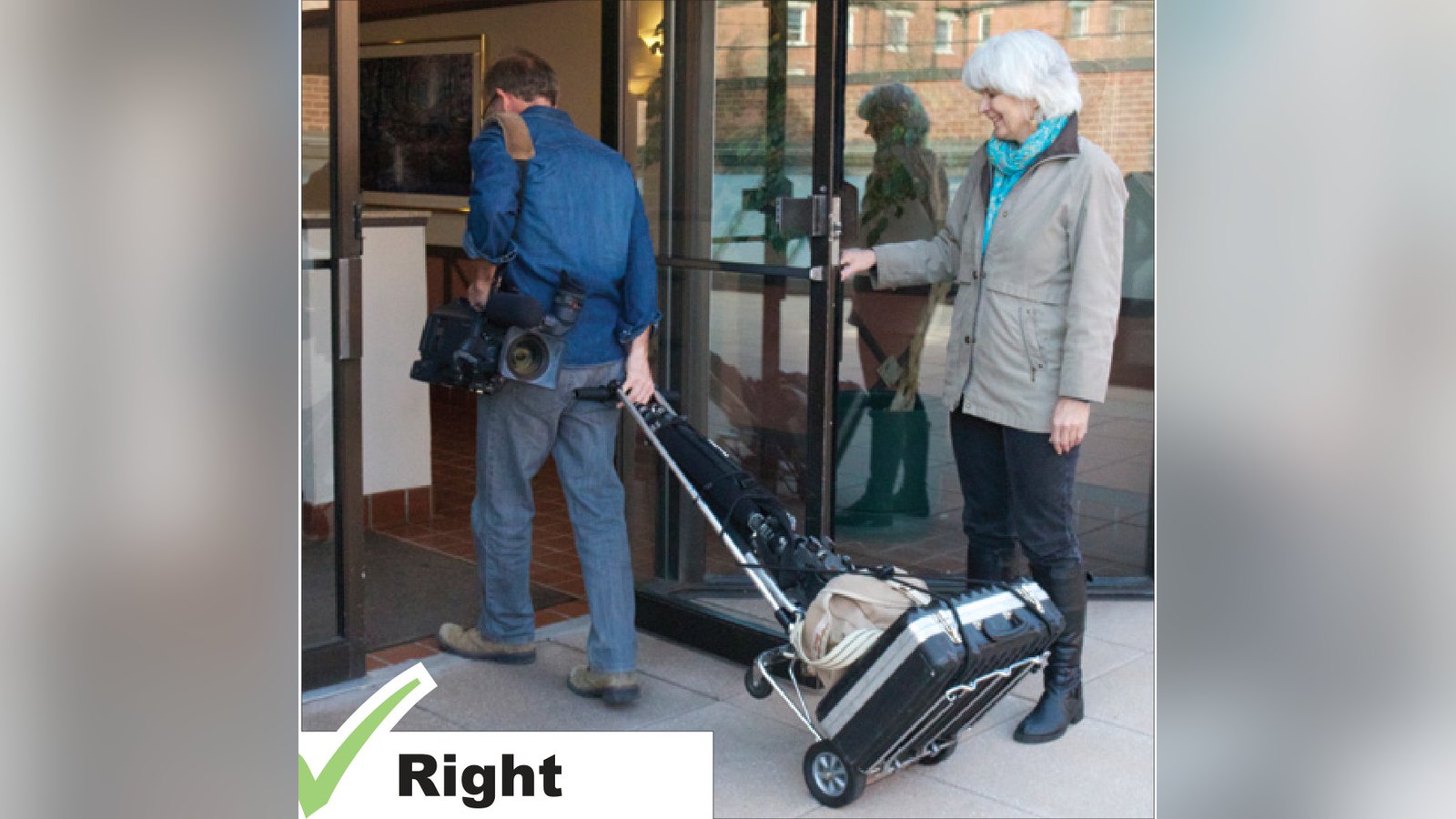
Given the opportunity, those of us controlling the technology can tinker happily all day. At some point you may have to say: "That's good enough for me" and go with it. One might assume that something as simple as opening a door for a crew or shooter with equipment would be a matter of common sense. I’ve lost count of the number of times this simple logistical detail became an obstacle. Here’s how it’s done.
- Doors that open out:
Pull and hold the door open, then wait for the crew and equipment to pass through.
- Doors that open in:
Push and walk though, then hold the door from behind, allowing unobstructed access for the crew and equipment.
When you are passionate about a story idea or documentary project, and loyal to your vision – insisting on the highest possible outcome -your project will find its audience. The Universe will cooperate with you to get you what you want. Fast. Cheap. Good.
You’ll be writing proposals, pitches, scripts and marketing copy. Good writing skills inspire trust in your competence. You’re taking someone’s precious time. Take only what you need.
Omit needless words. Omit needless words.
Some words read well but may not be effective when spoken.
The elements of a good story, in the order of their importance: A memorable close.
An engaging open.
The middle part.
Get someone to edit for you. Two heads are smarter than one. The rules of camerawork can also be applied to editing. Just as you want camerawork, lighting and audio to be unobtrusive, good editing must be seamless as well. I use a paper-based logging form on which I note the shot title, in/ out times, visual/audio cues and comments. It is a paper ‘rough cut’ that has saved countless hours of time and money I otherwise would have wasted in the editing room. Besides its simplicity and speed, the real beauty of this method – created with the help of architect Larry Halprin and designer Lily Fong-Endlich – is that that visualizing the edit allows more than one person to participate in the creative process. My logging form is based on a model Halprin used to design his architectural projects. (The FDR Memorial in Washington and Ghirardelli Square in San Francisco are two examples of Larry’s body of work.) When ordering wine at a restaurant, I often say to the server “Bring me something you enjoy. Then I’ll know at least one person likes it.” The same goes for editing. Let the editor recommend options. Try something. If you don’t like it, keep playing with it until at least one person (you) likes it. When a ‘talking head’ is well composed and has something compelling to say, let it play. Adding b-roll to cover long interviews bites is rude, like jabbing someone's shoulder while they’re engaged in an intimate conversation. Just as unmotivated camera movement is jarring to the listener, the brain needs a moment to absorb the new image following an edit. Don’t insert text or narration during a visual transition.
More from HD Pro Guide: get new production, broadcast and post stories every week with the free HD Pro Guide newsletter.
