

Shooting Miracles: 16 Guidelines for Filming in Medical Locations
From the HD Pro Guide Magazine archive: this article first appeared in HD Pro Guide Magazine, Vol. 2, No. 2 (2014). By Bill Zarchy.
It’s still dark out as we pull up to the hospital on a frosty Chicago morning at six. One of the nurses greets us quietly, and we roll our cameras, monitors, lighting and audio gear through the bowels of the hospital to the corridor with the operating rooms. In two hours we’ll be filming heart surgery.
We spend the time gowning up and cleaning our gear, chatting with the staff, and going over, for the umpteenth time, where to stand, when to put on our x-ray protection, how often the lights will go off and on, and how long we’ll be shooting continuously. Once the nurses and techs have prepped the room and the patient, the doctors arrive and things move quickly and calmly.
The doctor, whom we’ll interview later in the day, makes a small incision in the patient’s upper thigh, inserts a catheter in the leg artery and pushes it up through the chest into the heart. The patient, awake the whole time, receives a wire mesh stent to keep open a collapsing artery near his heart. It takes less than an hour, with little or no pain. Miraculous. Despite a recurring nightmare that I’ll asphyxiate a patient by standing on his oxygen line, my crew and I manage once again to behave ourselves. The procedure is a success, and the patient will be up and walking later the same day.
Things certainly have changed. When I was starting out as a camera assistant on a San Francisco crew shooting brain and open-heart surgery, the blood, sounds and smells of a power saw cutting through bone repulsed me like a horror movie. Since then I’ve worked in many medical settings: psychiatric training films for pharmaceutical companies, marketing films for medical imaging and equipment companies, TV series on medical ethics, and broadcasts teaching doctors new methods. Medical films can be immensely rewarding, promoting products with profound effects on people’s lives, more so than selling paint, cosmetics or the latest Silicon Valley widget.
Much of my recent work centers on minimally invasive procedures, starting with coronary angioplasty, a scientific triumph of the 1980s: a doctor threads a catheter through a small cut in a thigh artery and carries instruments through the arteries into the heart, and sometimes the brain. Small incisions, far less trauma and often no general anesthesia. Besides stents, I’ve filmed medical teams in the U.S., Europe, Asia and South America:
- Inserting and inflating a small (and expensive!) balloon to open blocked cardiac arteries
- Scraping plaque from the arteries around the heart with an abrasive tool the doctors call the “roto-rooter”
- Filling a brain aneurysm with platinum
- Using cardiac ablation, a pinpointed electrical shock, to zap an atrial fibrillation patient’s irregular heartbeat back into rhythm
- Using cryoablation to freeze abdominal tumors
- Probing the heart and other organs with rotatable, three-dimensional color imaging
Our projects focus on CT, MRI, x-ray, ultrasound and other advanced imaging used to diagnose and treat heart conditions and brain, breast and prostate cancers, among others. Usually we interview the doctor and the patient about the condition that forced the intervention and the often dramatic improvement afterward. When filming medical teams performing miracles, always do your homework, play by their rules and turn up your empathy for the patients.
16 guidelines for shooting medical procedures
- Scout before the day of the shoot. Nobody likes surprises, especially health care givers. Show up with plenty of time to inspect your location and to meet and plan with the people involved.
- Remember you’re disrupting their day. Filming people at work, whoever they are, disrupts their day. Some may welcome the diversion, but never forget that health professionals’ first priority is patient care, not your project. Figure out how to get what you need while staying out of their way.
- Arrive early. For surgery or other procedures that involve a lot of prep, come in with the nurses and techs, and set up as they do.
- Know where the sterile areas are, and stay away from them. For surgery with large, open incisions, the entire operating room may be a sterile field. For minimally invasive procedures there’s usually a smaller sterile area near the instrument table. Work out your physical access with the nursing and technical staff during your scout.
- Find out how long the procedure will last. If you need to leave before it’s over (as is often the case), plan your escape for easy exit, making sure your cables aren’t trapped and you can get everything out without disturbing the team.
- Know who’s who. The doctors are invariably the stars, but the nurses do the real patient care between the doctors’ visits, and the techs often really know how to drive the high-tech equipment. There are often four to six medical staff in the room, plus one or two from the film crew.
- Discuss the lighting with the people who work there. Most rooms have overhead fluorescents plus a powerful adjustable surgical light. The staff may have a particular workflow for the lighting, or may let you replace the overheads with your own, such as a Kino Flo in a corner (better for color and angle). In Europe I’ve seen a few “ambient rooms” with colored lighting to calm the patient, but they’re unusual.
- Ask about sound. Many procedures are accompanied by music to soothe and amuse medical crews who stand and work for hours together. If you need to record dialogue, they may be willing to give up their tunes, but ask ahead of time.
- Find out if the patient will be awake. If so, the interaction between patient and doctor can make interesting dialogue for your film. In one procedure in Belgium, the doctor and patient shook hands at the end, on camera.
- Respect patients’ privacy, personal space and possible embarrassment. I try to keep a respectful professional distance and avoid eye contact with patients on a ward or in rooms off a hospital corridor. Above all, don’t gawk.
- Remember that hospitals are full of germs, many of them on the floors. Years ago my crew was shooting in a hospital south of San Francisco. After several days, as we wrapped our cables to move departments, a nurse who had worked with us all week said, “After handling those cables, make sure you wash your hands before you eat. You know, this place is full of sick people.” Good advice: there was a staph infection rampant in the hospital at the time. Unfortunately she told us on day four, and about half the crew, including me, fell sick, some for as long as two weeks.
- Expect to wear scrubs, gowns, head and mouth covers and booties to protect the patient from your germs, plus lead jackets, vests and collars to protect you from x-rays. Follow the nurses’ and technicians’ instructions carefully. The heavy lead is often needed only for part of the procedure.
- Make sure the medical staff on camera are properly dressed. I’ve wasted hours shooting demonstration procedures with staff who weren’t wearing the correct head covering. They should know what they’re doing, but it never hurts to ask whether the equipment, garb and people will look correct to a discerning eye.
- Be ready to swab down your equipment with alcohol or another antiseptic to protect the patient; the hospital staff will tell you the protocol. No one expects you to slosh alcohol on your lenses or electronics, but clean your gear ahead of time, especially horizontal surfaces that trap dust and dirt, and allow time for it.
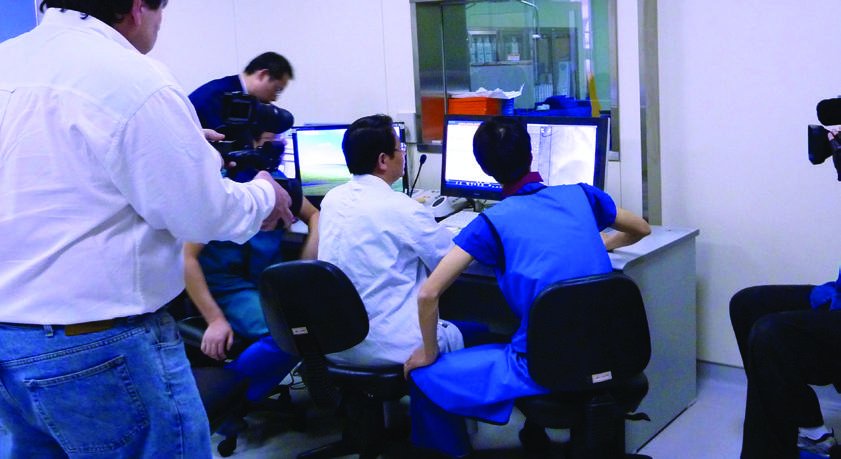
- Plan on two cameras if possible, because your ability to change angles may be very limited. In a small room it may be impossible to get decent coverage from one angle, and hard to move around. Doctors typically face a bank of monitors showing the latest medical imaging (often made by our clients), and you’ll need two angles just to show that setup and shoot close-ups of the screens, let alone an establishing shot or an angle on the patient. With MRI equipment, you can’t bring anything with metal inside the MRI room’s main door, though you may be allowed to leave the door open and shoot through it.
- Use long zooms and a tripod. You often won’t be very close to the action, and a long zoom lets you frame close shots. Use a tripod, because you may roll for an hour at a time; a tripod with a wheeled spreader is very useful if you have room to move. We often run a camera cable back to a video engineer who monitors and shades the shots as we roll through changes in room lighting. The casters on Sachtler wheeled spreaders have an adjustable cable guard, so you can push your camera or monitor cable ahead of you as you roll to a new position.
Basic precautions for any location
- Find out where power is available. Don’t plug your lights into the same circuits as medical or computer equipment, and bring plenty of stingers (AC extension cords) so you can bring power in from other rooms.
- Secure your cables so people don’t trip on them and carts and gurneys can avoid them.
- Tape lightweight cables across their length, running gaffer tape perpendicular to the cable. Taping along the length makes it more likely the sticky sides touch and fuse. When you wrap, pull up on the tape, not the cable.
- Fold back the end of the tape about half an inch to form a tab whenever you use gaffer tape or other sticky tapes. It makes the tape much easier to remove later, especially from carpet after a day of being walked on.
- Cover heavier cables with rubber or carpeted floor mats.
- Fly cables over doorways and halls whenever possible, especially where beds, gurneys or carts pass regularly.
Filming medical procedures requires responsibility and empathy. Recording a sensitive operation is a privilege not to be taken lightly. The most important thing, really the only important thing, is the wellbeing of the patient. If you set the rules with your medical hosts ahead of time, respect their needs and stay out of the way, you may be there at the moment someone’s health starts on the road to dramatic improvement.
More from HD Pro Guide: get new production, broadcast and post stories every week with the free HD Pro Guide newsletter.
