

“Take Condor!” Getting the Bird’s-Eye View with Condorcam
From the HD Pro Guide Magazine archive: this article first appeared in HD Pro Guide Magazine, Vol. 2, No. 1 (2014).
cablecam system that can reach spans of 1,200 feet and speeds of 40+ mph. Our 3 axis robotic head can hold an array of cameras, from the RED Epic to the Arri Alexa. We have covered action sports, have worked on commercial and feature film work. In 2012, I dissolved my former production company Trevnu Productions and brought all those services under one roof and CC brand. The added services to Condorcam are now RF services, RAILcam, Underwater DP , Steadicam, POV specialist and now production development with the CC-slider and CC-drive.
You've shot for television and film. could you tell us about some of the similarities and differences shooting for television versus film in your experience and capturing pov with Condorcam systems?
Jesse Placky: The similarities when shooting for TV or for a Film is the creative process. Talking with the director and finding out what is the expectation or vision of the shot. Then we determine the best flight path suited to the event or shoot with taking in all logistics involved, what will we use for Anchor points, are we getting in other camera angles, are there any obstacles in the way, etc.
There is a pretty big difference between shooting for TV or shooting for Film, especially when TV is a LIVE event. When Condorcam is shooting for live TV or a live webcast, we’re usually covering a section of a course or the whole course. At that point, we are capturing a broad spectrum of the action, keeping the subject in frame and tracking along side them. We’re considered the “game” camera; taking in the whole perspective of the event. It’s a dynamic way to engage the viewer, along with the beauty shots we are used for coming in and out of commercial breaks. If the event is not live for TV and we’re covering action, we’re usually let free to get creative, try different things, like focal lengths, leading or following subject, switching directions and banking as many different creative angles as possible within that flight path.
When we’re shooting for a film or commercial, we are brought in for a specialty shot. Usually the director had a vision of a camera move and we’re brought in to execute it. We have done film work where we’ve taken a whole day to set up a shot and have done two takes, then we strike the system. The big difference is in TV we’re usually following action for hours, trying new angles, the production wants to get their money’s worth. In film work, shooting times can be so tight, we often don’t have time to sell the director on other looks, they got the shot they need and are ready for a set change.
What makes shooting for television unique to shooting for film in your experience?
Jesse Placky: I find with TV there is a stress and excitement of getting the shot or being prepped and ready to go when the director says, “Take Condor”. Being ahead of the next move and ready for anything is the name of the game in TV. There are a lot of surprises and unpredictable shots we’ve captured all by being at the right place and time. With film work, shots tend to be a little more scripted, which is awesome when it all comes together. When we take the time to script shots out, we can get our camera in pretty tight places and reveal from tree branches or through window frames.
Can you share with us some of the interesting and unique things that are involved in the flow and technical side of live television and events, as it relates to capturing pov angles and SPECIALTy shots with Condorcam systems?
Jesse Placky: Setting up the Condorcam cablecam system, we usually have a set day or sometimes 2 set days depending on the production. I always like to inform people, having a cablecam on a production is 80% rigging and 20% operation. If the system is not properly anchored or the person setting it up doesn’t know their limits on loads, there can be catastrophic problems. Each job we do is different and has it’s challenges, I think that’s why I’m drawn to this work. When working with a live TV production, it’s one more element of set up. Getting our signal back to the truck can be a challenge sometimes. We operate the Condorcam system from one of our anchoring points, and sometimes that’s not always the closest area to the truck. Getting the continuity between the truck and our operations area can be a challenge, like our comms and a program feed back to us so we can have a reference of the show. It’s one more element of the production that has to be thought out.
In addition to aerial CINEMATOGRAPHy and production, Condorcam systems and services also include capturing pov using Steadicams, sliders, and motorized dollies. can you tell us more about the CC-slider and CC-drive?
Jesse Placky: Condorcam has expanded its services over the years and we find that every specialty shot we cover, from Jibs to Steadicams, it helps us understand how to use moving imagery into a project. The RAILcam was created because a client had asked us to make it, the director wanted a dolly with a robotic camera, but could have your classic dolly op and grip pushing behind, the venue was too small. We took our knowledge from the cablecam and moved it onto rails. To be honest, it was a harder product to develop, because the rails had to be inlined with precision so the connections were smooth. After using it on a few shows, I saw a need for this product for Concerts, Fashion Shows, and even conferences. Being low profile, it can sit directly on the stage and not block anyone’s view.
After I made a few products, the engineer in me came out and Condorcam has knocked out a couple products last year. It all started with a bet actually. My buddy was looking at sliders on the market and he couldn’t find one that had it all, he turned to me and said, ‘I bet you can make something better.” So the CC-slider was born. I made it for him, it had everything he was looking for, travels easy, can be mounted to almost anything, does video moves and time lapses and because the camera carriage sandwiches the rails, it can be used diagonally or vertically. The CC-drive was created similarly. A friend in the industry had a Dana Dolly and asked if I would motorize it for him. Once people started coming to his studio and he showed the CC-drive to them, the demand was there. The CC-drive is a clamp on unit for handheld dollies, like the Dana Dolly. It’s a direct drive, meaning the wheel has direct contact with the rail itself. If you have a Dana Dolly, it’s ridiculous not to have this add on, it makes all your moves steady and smooth with a range of speeds. We also have a time lapse motor for this as well that comes with the kit.
By the way, what is one of your most favorite or memorable aerial production experiences? Jesse placky: one of my most
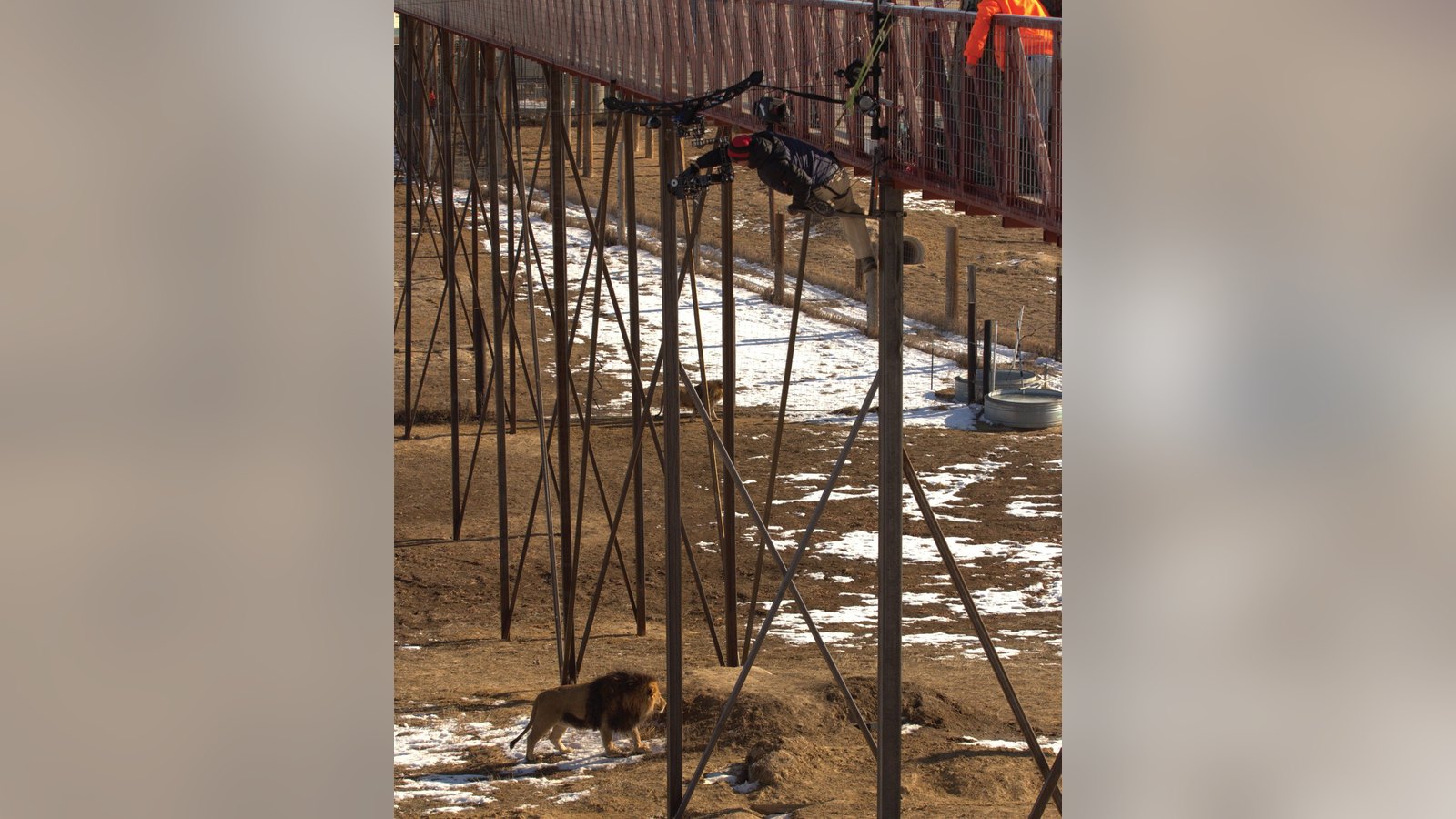
memorable shows was a few years back, when I had a chance to collaborate with Hans Rosenwinkle and Tyler Duke for a project called Mile High Jungle for Nat Geo. They were covering Pat Craig and his team from The Wild Animal Sanctuary (just east of Denver, CO) rescue wild animals from situations that Jesse with Whales.
Photo Credit: Aaron Chang. were inhuman. The reality show followed Pat and his team to other countries on some hairy rescues, but Condorcam was asked to come out to the Sanctuary to shoot some establishing shots. We got the opportunity to fly over Lions, Tigers and Bears! I’m an animal lover and seeing the curiosity in the animals with the camera flying over head turned 800lbs tigers into playful house cats. Tracking a tiger staring down the lens was pretty moving for me.
Could you also share with us one of your most favorite or memorable underwater production experiences? Jesse placky: so I’m a land locked
Surfer and Diver. When people hear I’m an underwater DP in Colorado, they question why I’m not on the coast. It’s simple, love the mountains, and I also love the Ocean too. I appreciate the ocean that much more when I travel for an underwater shoot. The most memorial shoot as an underwater DP was last year for Kurt Miller’s The Current. I was the fortunate one who got to go to Kauai and Tonga for the documentary about the healing powers of the water for those with disabilities. The highlight was working with an amazing cast, but also diving with Humpback Whales in Tonga. It was surreal to be in the water with them next to you, it is a bucket list item for sure.
Are there any future plans for Condorcam that we should know about? Jesse placky: Condorcam is always
evolving and researching new technology. We have integrated the Movi from Freefly systems with both the cablecam and RAILcam on certain shoots and have been really pleased with the results. You can sign up for our newsletter on our website or check out or facebook page for the latest productions.
If you could share some quick tips related to capturing pov angles and SPECIALTy shots, what would they be?
Jesse Placky: I’m going to talk directly with POV shots here. With the GoPro revolution, it seemed like everyone became a POV specialist overnight. It was my bread and butter for years. Three tips would be. First – be sure to frame the shot properly. Frame what you want to see and be aware of other movement in frame and how it could affect the overall shot. Second – give the viewer a frame of reference, rather than just a helmet cam, where the image is just “floating” through space on a mountain biker for an example, put the camera on the frame where you see the handlebars. That fixed item (handlebars in lower frame) gives the viewer a better sense of speed and perspective. Third – have fun with it. Try new things, so of my best looks have come through experimenting.
Tell us about condorcam's newest products.
Jesse Placky: Condorcam is now selling two products, the CC-slider and the CC-drive. It’s a new adventure and a whole separate business model than a service driven company that I have ran for the past 10 years. I look forward to the challenge and hope this allows Condorcam to provide useful tools for other filmmakers. You can find out more on our website Condorcam.com and please feel free to reach out and discuss how we can help your next production with our services. The great thing about using Condorcam, because we capture all sorts of moving images, we can best help you decide what system will suit your needs.
What cameras are compatible with your Condorcam systems for aerial shots, underwater shots, and other pov angle and SPECIALTy shots?
Jesse Placky: Condorcam made its systems to be compatible with most cameras. We have a payload of 25lbs on our head, which pretty much fits most cameras. We use a Sony P1 style POV camera over a larger Sony 900 style handheld camera because of the length of the camera. The heaviest Rig we’ve flown in a RED One camera with a 50mm prime lens. Now with all the cinematic cameras getting smaller, we haven’t ran into a problem getting the image quality that our clients are happy with. I’d say we Fly the RED Epic camera 70% of the time. Photos courtesy of Condorcam.
RAIlcam. Photo Credit: David Townsend
More from HD Pro Guide: get new production, broadcast and post stories every week with the free HD Pro Guide newsletter.
