

A Tale of Two Cameras: Solving the Same Live Production Problem Two Ways
From the HD Pro Guide Magazine archive: this article first appeared in HD Pro Guide Magazine, Vol. 2, No. 3 (2014).
Two very different cameras announced in 2014 tackled the same problem in two very different markets: the need for purpose-built but affordable cameras. The Blackmagic Studio Camera was designed for live production, and the Blackmagic URSA for film and on-set work.
Live production with the Blackmagic Studio Camera
Live production crews often have to use cameras designed for general video work, which means they miss features live shows demand. The Blackmagic Studio Camera was built to deliver those features, including a large viewfinder, talkback, tally, optical fiber and a tough metal body, in HD and Ultra HD models priced at $1,995 and $2,995.
Inside its magnesium alloy body are a 10-inch viewfinder, a four-hour battery, talkback, front and rear tally lights using the tally-over-SDI protocol, phantom-powered microphone inputs, and built-in optical fiber and SDI connections, so a single cable can connect the camera to a switcher for camera output and return monitoring. It also has dual balanced XLR mic/line inputs with switchable phantom power, a headset jack for talkback, LANC remote control and a standard 4-pin XLR 12V DC power input. It shoots 23.98, 24, 25, 29.97 and 30 fps, up to 60 fps.
How it supports a live workflow:
- A big viewfinder. Small viewfinders make framing and focusing hard. The 10-inch LCD is very bright with a wide viewing angle, so it works even in direct sun, and a large fold-up sunshade doubles as a privacy shield.
- Flexible lenses. An active Micro Four Thirds mount takes a wide range of lenses and adapters: photo lenses for small or fixed-camera setups, and broadcast ENG lenses for large shows through an MFT-to-B4 adapter. Crews can start with affordable photo lenses and move to ENG glass as their business grows.
- One fiber cable. The built-in, bidirectional fiber connection carries HD or Ultra HD video with embedded audio, talkback, tally and camera remote control over a single thin tether. Talkback works with common general-aviation headsets, which offer good noise canceling at low cost.
- Tally and power. The camera supports the SDI tally standard used by ATEM switchers, with a front light for talent and a light above the viewfinder for the operator. The four-hour battery covers long shows plus setup time, so one fiber cable is all the camera needs.
- Fast controls. An operator-side panel gives instant access to focus, iris and on-screen menus, which slide on and off over the viewfinder image.
On-set workflows with the Blackmagic URSA
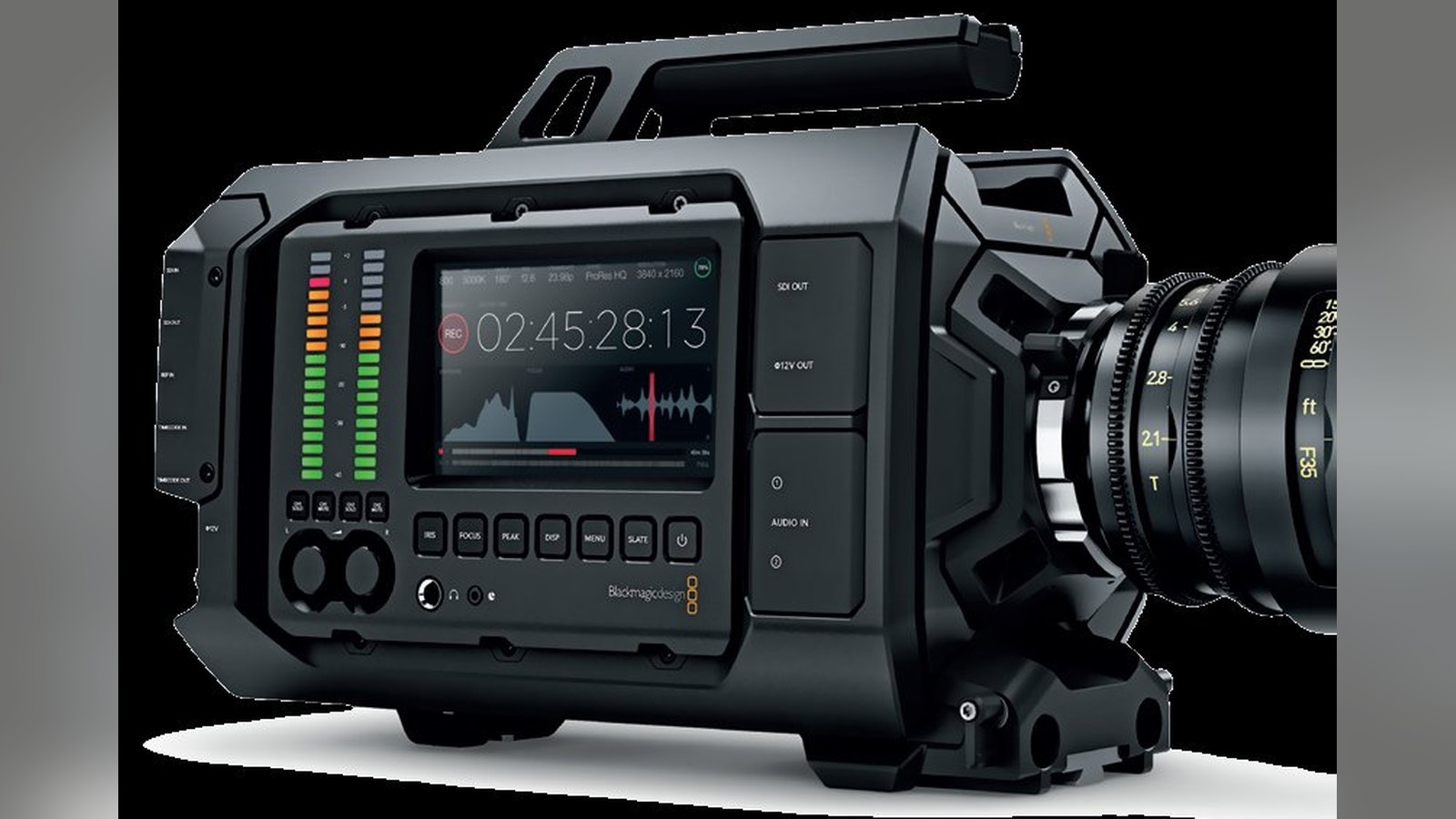
The Blackmagic URSA was a high-end digital film camera with many accessories built in, so it could serve a large film crew or a single operator on features, commercials, episodic TV, documentaries, ENG and music videos. With scopes for exposure, focus and audio, dual recorders and a 10-inch fold-out on-set monitor in the body, it cut the cost and time of extra on-set equipment, and it could still be rigged with cinema lenses, rails, follow focus and matte boxes.
For larger crews, the body is divided into workstations. The DP side has the 10-inch fold-out monitor and a separate 5-inch screen for settings, status and scopes. The camera assistant side has another 5-inch screen for settings, status and scopes, and an audio station holds meters, controls and connections. Shooting solo, the fold-out monitor, scopes and internal recorder replace extra gear.
The URSA had a user-upgradable Super 35 global shutter 4K sensor and dual CFast 2.0 recorders for unlimited-duration recording in RAW and Apple ProRes, priced at $5,995 for the EF mount and $6,495 for the PL mount. Its 12 stops of dynamic range give a feature-film look, the Super 35 sensor allows shallow depth of field, and Ultra HD 12-bit lossless compressed CinemaDNG RAW and ProRes keep post workflows easy with modest storage.
Connections include dual XLR mic/line inputs with phantom power, 12G-SDI output with status overlay, a separate 4-pin XLR viewfinder power output, 12G-SDI monitoring input, headphone jack, LANC, 4-pin 12V DC power and built-in stereo microphones. It supports quick-release tripod mounts and V-Mount or Anton/Bauer battery plates, and came with DaVinci Resolve. Frame rates run from 23.98 to 60 fps, and liquid cooling keeps the chassis cool and the fan quiet for future higher-frame-rate sensors.
A modular turret holding the sensor, lens mount and lens control connection can be swapped by removing four bolts. URSA came in four models: URSA PL and URSA EF with the Super 35 global shutter sensor, an URSA Broadcast B4 model with an Ultra HD broadcast sensor and B4 mount, and an URSA HDMI model with no sensor, replacing the mount with a “cheese plate” and HDMI input so any third-party camera can use the URSA body’s features.
More from HD Pro Guide: see more live production coverage, and get new stories every week with the free HD Pro Guide newsletter.
